Aleister Crowley: The Beast Demystified: Review

Aleister Crowley was one of the most colourful characters this country has ever produced.
It’s not surprising that over the years countless biographies have been written about the so-called “Wickedest Man in the World.”

One such book is “Aleister Crowley: The Beast Demystified” by Roger Hutchinson, which I picked up at a used book stall in Tynemouth.

Hutchinson provides a rather satisfactory discussion of Crowley’s upbringing with the Plymouth Brethren, education at Cambridge, mountain climbing expeditions, as well as his various lawsuits and scandals.

However, sometimes the book is more like “The Beast Un-detailed” than “The Beast Demystified.”
Crowley’s magickal practices and Occult religion, Thelema, are hardly touched upon at all.
Occult organisations such as A.’.A.’. are hardly mentioned. The Ordo Templi Orientis is only mentioned once, in a very passive manner.
Hutchinson does discuss Crowley’s time with Hermetic Order of the Golden Dawn but focuses on the fallout surrounding the organisation.
For example, Crowley published details of their secret rites in his magazine “The Equinox.” This led to the organisation’s founder Samuel MacGregor Mathers, taking Crowley to court. Hutchinson covers the case without telling us anything about these rites at all.
Significant figures such as J.F.C Fuller and Leila Waddell become mere background characters in the narrative of Crowley’s life. 
Others, such as Israel Regardie, Grady McMurtry and Dennis Wheatley go unmentioned.
Readers with prior knowledge of Crowley’s life will be able to see that some aspects are completely glossed over.

Crowley certainly possessed many negative qualities. I think even dedicated Thelemites would have to admit this. But Hutchinson fixates on these qualities. He has almost nothing positive to say about Crowley. The book has a heavily biased tone.

Given that he doesn’t like Crowley and has no interest in Magick, I can’t help but wonder why Hutchinson bothered to write about the Beast at all.

As much as I’ve enjoyed revisiting the adventurous life of the Master Therion, I do wish I’d read a better biography.
I’ve heard a lot of good things about “Perdurado” by Richard Kaczynski. Perhaps I should have read that instead.
The Nomads Journey

James Ellis – best known for his work on the Hermitix Podcast – has published three books which collectively make up an autobiography of his own internal life.

Between 2017 and 2021 he wrote a blog under the name “Meta-Nomad.” These writings were collected in a book titled “Exiting Modernity.” Here he critiques education, consumerism, contemporary attitudes and just about everything we see and experience in the modern world.
Unlike other anti-modernist thinkers – Ellis does not write from a grand metaphysical standpoint. Instead he writes from a perspective that’s a lot more personal. This makes the work more relatable and I think this is why the book was such a success.

Ellis also published a work of theory fiction titled: “A Methodology of Possession: On the Philosophy of Nick Land“. In one of the early episodes of the Hermitix podcast Elis interviewed Land on whom he also taught an online course and wrote several essays on. Its clear to see this was a thinker Ellis was deeply fascinated by. In the second chapter of the book the unnamed narrator expresses his dissatisfaction with the modern world – mirroring the views and attitudes that Ellis previously expressed on his blog. However here the expression feels much darker. Its hard to tell if this tone is a genuine expression of his feelings or purely to fit with the gothic themes of the book. The narrator becomes increasingly nihilistic leading him to cut ties with institutions, family, friends and the world as a whole.
Then browsing the internet late one night he comes across the work of Nick Land on a long abandoned message board.  This inspires him to partake in a strange Magick ritual bringing him into an Occult-fuelled psychosis in which he explores Lands philosophy. It is a journey filled with bleak and surreal visions. His situation worsens as he sinks deeper into a grotesque hellscape where he is left to wallow in his Nihilism.

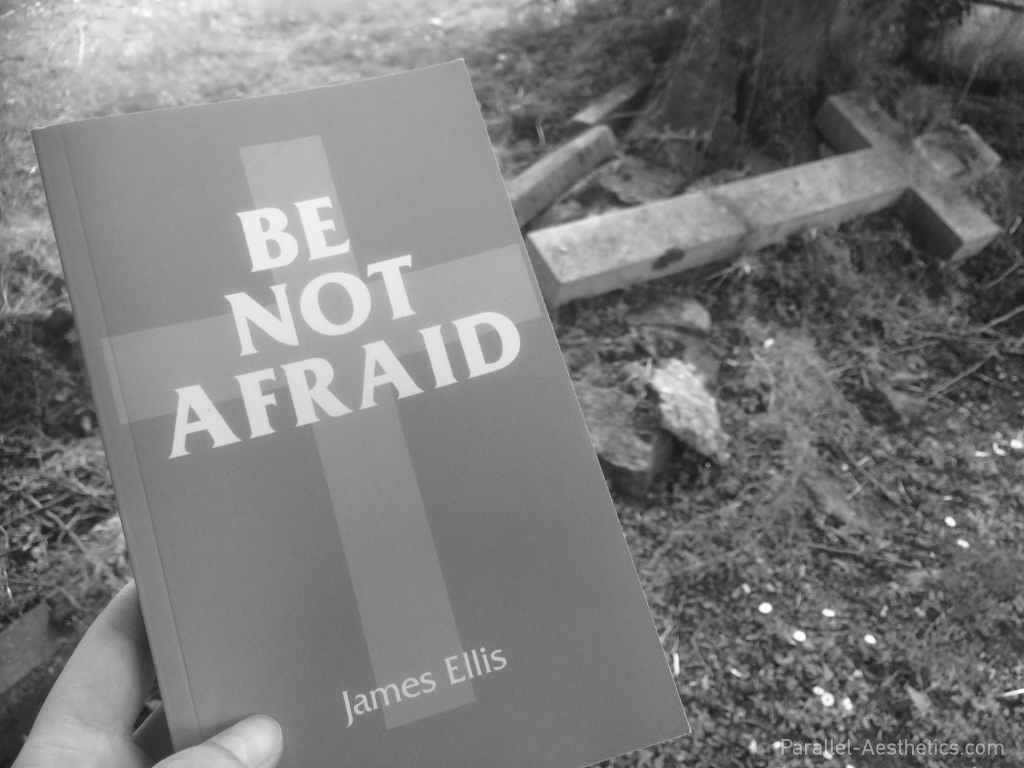
His most recent publication was a short novel called “Be Not Afraid.” It follows an unnamed protagonist – a young man – who works in the basement of a bakery. Every day is the same, time seems to disappear (its interesting that Ellis associates a state of non-time with nihilism). His manager is a rather eccentric figure called Ollneek who is more than happy to share his unsolicited cynical opinions on just about everything.
The young man feels the same sense of emptiness that Ellis has described in his other works. Its a feeling  worsened by Olneek’s frequent ramblings.
Eventually, various guardian angel figures intervene – we see Ollneeks sinister influence for what it really is and the young man finds his way to salvation.

The tail is a sort of parable in which Christianity triumphs over nihilism.

The emptiness of the modern world led Ellis to sink deep into the depths of nihilism – unable to go any further he looked upward and found a sense of meaning in Catholicism.

Collectively his works detail his inner journey – the journey of the Meta-Nomad but where he travels next is something yet to be seen.