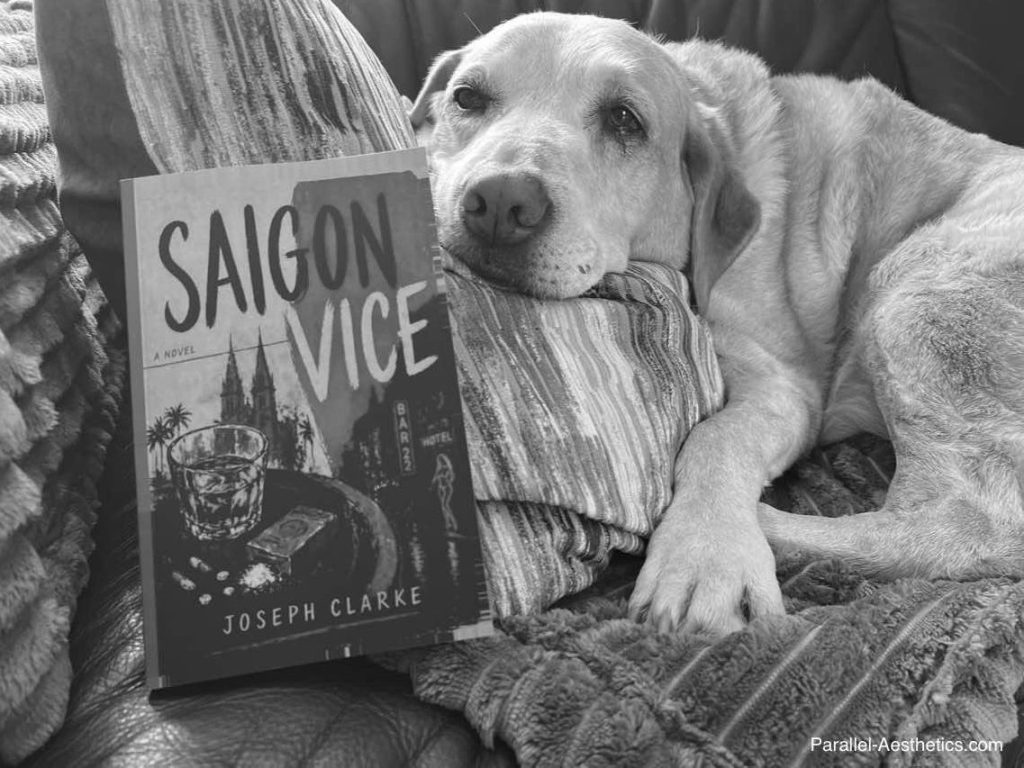
Saigon Vice [Book Review]

H.L. Mencken once wrote: “Every normal man must be tempted, at times, to spit on his hands, hoist the Black flag, and begin slitting throats.”
Well, Joseph Clarke, author of Saigon Vice, tells us that a normal man may be tempted, at times, to quit his job, move to Vietnam and begin teaching English. 
He also tells us what happens to a man when he acts on this temptation.

Saigon Vice follows Dan, thirty years old and sick of life in suburban Warwick. He has a meaningless job, a loveless relationship, high prices and cultural passivity leave his social life barren. A stagnant lifestyle all too common in modern Britain.
When Dan learns that he can make a living teaching English abroad, he quits his job, leaves his girlfriend and moves to Saigon.
The city roars with the sound of motorbike engines. Pollution fills the air. Luxury hotels and skyscrapers loom over the poverty-stricken streets. Communist imagery contrasts a capitalist reality.
Dan soon finds himself deep in an underworld of expats, who take advantage of the low cost of living and poverty-induced desperation.
During the day, Dan works at the “Fun Speak” language school. At night, he hangs out in seedy bars and bordellos, where he can satisfy every impulse and hedonistic desire.
The longer Dan spends in the city, the deeper he drifts into the underworld. Eventually, he becomes lost in a haze of hookers and cheap booze.

The chapters are short and resemble well-written anecdotes. They can be chaotic, they can be perverse, they can be sad, they can be funny. As the story progresses, they become increasingly unhinged. Together they tell the tale of a man who becomes lost in his own addictions.

Out of all the fiction I’ve read this year, Saigon Vice certainly stands out. It’s articulately crafted yet easy to read. The mix of sharp prose and casual language makes the story feel real. I found the novel to be an entertaining yet devious read.

Saigon Vice was independently published and distributed via Amazon’s print-on-demand service.
It’s understandable that Clarke wanted to avoid the Kafkaesque farce that is contemporary publishing, however the book risks getting lost in the digital deluge.
Clarke’s decision to use an AI generated cover acts against him as potential readers may dismiss the book, assuming the text is a computer generated cash grab.
I think it would be an awful shame if a great book like Saigon Vice is overlooked. Don’t judge a book by its cover and order a copy of Saigon Vice.


Jim and The Pigeon [A Very Short Story]

The rain had stopped and the sky was an ugly shade of grey as Jim wandered down the high street.
He felt his phone vibrate in his trouser pocket. It was a text from his wife. She’d finally left him.
Jim looked down at his phone in disbelief while trying to hold back the tears.
He looked up from the small cracked screen and decided to get something to eat.
As he began to move he stepped in a puddle. The cold water soaked into his shoe and sock.
He wandered down to Tesco and purchased a meal deal consisting of a prawn mayo sandwich, a bag a crisps and a soft drink.
Jim wandered back through the high street and found his way to an empty park.
He sat down on a bench but it was still wet.
He took the sandwich out of the packaging. As he ate a single prawn fell from the sandwich leaving a white streak of mayo down his shirt landing on his trouser leg.
As he opened the bag of crisps a pigeon flew down hoping that Jim would drop some food.
Jim occasionally tossed it a crisp. The pigeon pecked at it then strutted about and cooed.
Jim watched the pigeon enviously.
The pigeon didn’t have to worry about who would clean the mayo from his shirt. The pigeon didn’t have to worry about his shoes, socks, trousers or shirt getting wet. The pigeon didn’t have to worry about his wife leaving him. The pigeons wife would never leave him.
In that moment Jim wished that he were that pigeon.
The bird flew away. It began to rain again.

All Rights Reserved.

The Cleaner: A Very Short Story

Alan worked as a Cleaner. 
He worked for a company that contracted cleaners for various businesses. They mainly provided services for offices and shops. 
Alan was contracted to work in a shop. It was one of a large chain that ran across the county. 
The shop was no more than a fifteen-minute walk from where Alan lived. He would walk there every day, arriving at 6 p.m.

Once there, he would sign in, call head office to tell them he had arrived, then go to the cleaning cupboard and gather the few things he needed to work. 
He would begin by cleaning the staff-only bathrooms because they were closest to the cleaning cupboard. 

He would then move on to the staff break room, where he would mop the floor and wipe down the cheap Formica table and the counter top, ignoring the scattered coffee cups left to dry by the sink. 

He would then carry the mop, bucket, and a few other things to the storefront while dragging behind him a vacuum cleaner by its long black nozzle. 
He would then mop the floor, clean the hand prints off the glass door, and vacuum the large carpet doormat by the front door. 
Much to the curiosity of the staff, he would mop the concrete just outside of the glass door and vacuum along the very edge of the long cashier’s desk. 
Much to the dissatisfaction of the staff, he would then empty the mop bucket in the break room sink. However, no one ever said anything about this to him.

He would then return the cleaning equipment to the cupboard, sign out, call head office to tell them he was done, then walk home. 

Alan had followed that routine every weekday for the last five years. In those five years, no one at the store had said much more to him than “Hello” and “Goodbye,” apart from at Christmas time, when they wished him a “Merry Christmas.” On one occasion, a female manager told him he needed more vacuum bags, to which he said, “Okay.”
In the five years he had been cleaning the store, he had seen many members of staff come and go. Only a few managers remained the same. 

On one summer evening, a young man who had spent the last six months working at the store spoke to Alan while he mopped the shop floor. 
“It’s pretty quiet tonight.”
“Yeah.” 

“Makes you wonder why we stay open until 8 p.m.” 

“Yeah….everyones probably out in the nice weather or watchin’ the football.”

“Yeah.”

In his five years of cleaning, this was the longest conversation Alan had ever had with anyone at the store.
 It would be another five years before he had a conversation like this again.