I found myself browsing copies of After The Sun every time I visited my local Waterstones. Eventually, I gave in and bought a copy. I should have done so sooner. After The Sun is the second book by Jonas Eika and the first to be translated into English. It contains five short stories (the final story being a sequel to one of its predocessors). Each story reads like a vivid dream about cryptic relationships, hypnotic addictions, and psychic callings taking place in various backdrops. The streets of Copenhagen, the bleak corners of London, and the beaches of Mexico all become roads to twisted underworlds. Dark and intimate, the writings of Jonas Eika occupy a strange and uncharted space between the works of J.G. Ballard and Bret Easton Ellis. Eika is a writer still at the beginning of his literary career. He has already gained critical acclaim and won the Nordic Council Literature Prize. I’m interested to see where this promising writer will go from here.
In 1974 Werner Herzog was informed that his close friend Lotte Eisner was sick and possibly dying. Determined to see his friend the auteur director set off on a pilgrimage from Munich to Paris on foot. He departed on Saturday 23rd November and finally arrived on Saturday 14th December. Everyday he wrote an entry in a diary documenting his journey. The diary was published in a thin volume titled “Of Walking in Ice,” which I found in a used book store then began on 23rd of November and finished on the 14th December, reading each entry forty-nine years after it was penned by Herzog. Herzog describes the various sights he seen on his travels which he sometimes lists vaguely and other times describes in vivid and poetic detail. He tells us of the pains he suffers, the harsh weather, the grim landscapes of desolate road sides and decaying villages, the strangers that watch him with curiosity and suspicion and his almost hallucinogenic day dreams. Over all Herzog provides us with an account of a unique experience that is poetic, dreamlike and memorable.
In 1970 journalist Hunter S. Thompson set out to write an article on the death of Mexican American news reporter Rubén Salazar at the hands of the Los Angeles County Sheriff’s Department while covering the National Chicano Moratorium March against the Vietnam War. Thomson met with attorney, writer and Chicano activist Oscar Zeta Acosta who was to be his central source for the article. However the two men found the atmosphere of Los Angeles to tense to talk openly. Thompson had been asked by another magazine to help cover the Mint 400 – an annual race through the Mojave desert. The two decided to take advantage of this assignment and head to Las Vegas. Thompson completed the article that would be titled “Strange Rumblings in Aztlan” as well as his assignment on the Mint 400 but the drunken and drug fuelled antics of that now legendary road trip would become the basis of Thompson’s semi-biographical novel “Fear and Loathing in Las Vegas.” In this roman à clef Thompson takes on the name Raoul Duke and assigns Acosta the pseudonym Doctor Gonzo. Duke is a journalist sent to Las Vegas to cover the Mint 400. He and his attorney Doctor Gonzo acquire a fast red spots car and all the drugs they can get their hands on before driving to the city of sin in a drug fuelled haze. Their time in Las Vegas becomes increasingly more chaotic as strange substances are taken, hotel rooms are trashed and deadlines loom closer. Artist and friend of the author Ralph Steadman would provide several illustrations for the book. His twisted figures serve as a perfect companion to the story.
Originally met with mixed responses due to its loose plot and controversial subject matter the novel was eventually recognised as a modern American classic. It would find its way into the hands of a new generation thanks to a cult classic film adaptation released in 1998 directed by Terry Gilliam, starring Johnny Depp and Benicio del Toro in the leading roles. Like many I read “Fear and Loathing in Las Vegas” as a teenager after I seen the film. At the time the psychedelic adventure and Thompson’s antiauthoritarian attitude appealed to me. Last week I re-read it for the first time and I’m glad that I did. The wild antics still amuse me and the weird humour still makes me laugh. But what really stood out to me this time was Raoul Dukes sense of anxiety and paranoia – his fear and his loathing – that consumes him as he walks out of the hotel leaving his sky high room service bill unpaid, as he disposes of his incriminating rental car and taking out a few one on bad credit and then checks into a hotel full of cops to cover the District Attorney’s Convention on Narcotics with a suitcase packed full of highly illegal substances. But wild antics aside in this book Hunter S. Thompson managed to capture the world-feeling of early 1970s America. Images of Richard Nixon and the Vietnam war illuminate a television screen as Duke comes down from a bad acid trip. Scattered references to the Manson family expose the scar that the Cielo Drive murders left on the American psyche. Thompson shows just how out of touch the establishment were as a passel of police officers listen to an alleged expert give an inaccurate lecture on a drug culture long gone. But most notably Thompson discusses the fading American Dream and in a sobering section often dubbed “the wave speech” he explores the anticlimactic end of the counterculture of the 1960s.
I recently finished reading The Shards – a new novel by Bret Easton Ellis. Before now, I’d only read his first novel, Less Than Zero, and his infamous American Psycho. Both of which I thoroughly enjoyed. I read both of these books several years ago, and since then I have always intended to read more of his work but never really got around to it until the American author released this new work of auto-fiction. It took me a while to read, not just because it’s rather long, but because I wanted to savour the atmosphere and feeling that Ellis sustains throughout the story.
In The Shards – Bret Ellis – now in his mid fifties- reflects on events that have haunted him since his senior year at Buckley High School. The story is set in 1981; the young Bret Ellis and his friends are the sons and daughters of LA’s social elite. They live a lifestyle of wealth and excess. They wear designer clothes, drive expensive cars, frequently attend parties, and have easy access to drugs at all times. The city of Los Angeles is being prayed upon by The Trawler, a sadistic serial killer who stalks his victims, breaking into their homes and stealing their pets before kidnapping and, of course, killing them. As well as a hippie cult that emerges from the mountains to embark on a campaign of harassment and vandalism. At the start of the new school year, Robert Mallory transfers to Buckley High and quickly infiltrates Bret’s tightly knit social circle. Bret quickly becomes suspicious of Robert – rightly believing that he’s not exactly who he seems to be – and begins to investigate his new class mate. Bret, however, is hiding secrets of his own. His girlfriend, The popular Debbi Schaffer, has no idea that he’s actually gay and having affairs with two male classmates. These are secrets he can’t let anyone else know. He can’t disrupt the social norms of life at Buckley High – something that does eventually becomes disrupted as Bret slowly learns the truth about Robert.
Ellis manages to paint a vivid picture of the era and the city of Los Angeles as he lists the familiar names of streets, bars, and restaurants. As I previously stated, he manages to maintain a certain atmosphere throughout the fairly long book—a wild cocktail of desire, detachment, paranoia, jealousy, and suspicion—which occasionally verges on psychedelic, like a bad trip with an 80s soundtrack. The Shards is a coming of age story from hell.
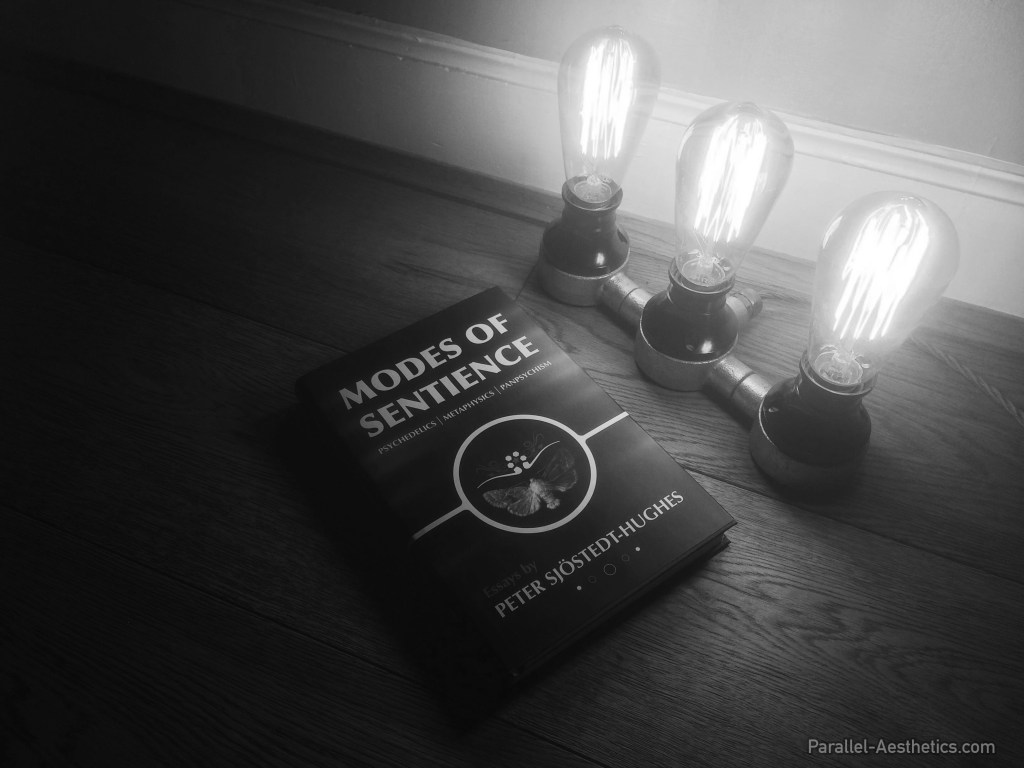
Six years after the publication of Noumenautics (2016) Dr. Peter Sjöstedt-Hughes brings us a new collection of essays, Modes of Sentience, in which he continues his exploration of Psychedelic experience, Metaphysics and Consciousness. Unlike this previous book there is no exploration of Meta-Ethics.
Many of the chapters are deeply complex such as “The Great God Pan is not Dead,” which explores Whiteheads Metaphysics in relation to Psychedelics perception and “Deeper then Depth,” which explores space and sentience. I don’t want to summarise these more complex essays here. Doing so would take up to much space for this to remain a simple review and I do not think a short summary would present such ideas adequately. Instead I will briefly discuss what could be seen as the more “approachable” essays.
“The Concrescence of Dissent” is a fantastic essay exploring the development of Alfred North Whitehead within the Religious and Philosophical context of his time – showing that Whitehead stood as a heretic amongst his contemporaries. An interesting article for those both new to Whitehead and those already knowledgeable of his work.
The book also contains perhaps one of Sjöstedt-Hughes most significant essays: “The Psychedelic history of Philosophy.” Which gained almost instant popularity after its original publication in Mid-2016. This essay explores the hidden influence of Psychedelics have had on Western Philosophy exploring usage from Plato to Foucault. Here Sjöstedt-Hughes provides us an alternative view of Western Philosophy and discusses figures both well known and obscure.
One such obscure figure is Sir Humphry Davy, who is further discussed in the essay “The First Scientific Psychonaut.” Davy is best remembered for inventing the miners lamp and isolating several elements however he want on to experiment heavily with Nitrous Oxide – inspiring a poetic philosophy of Metaphysics of which Sjöstedt-Hughes explains in detail.
Modes of Sentience is a compelling and complex read. I wish not to discourage or criticise by mentioning its complexity – I enjoy a challenging read. I don’t think ideas like these can be presented simply and in many ways I feel this book continues on from the writing he presented several years earlier – Modes of Sentience brings us deeper into Sjöstedts Psychonautic voyage. But we have further to travel yet as in the past Dr. Sjöstedt-Hughes has stated that he hopes to combine the metaphysics of Whitehead with the philosophy of Nietzsche.


 Parallel Aesthetics