The Nomads Journey

James Ellis – best known for his work on the Hermitix Podcast – has published three books which collectively make up an autobiography of his own internal life.

Between 2017 and 2021 he wrote a blog under the name “Meta-Nomad.” These writings were collected in a book titled “Exiting Modernity.” Here he critiques education, consumerism, contemporary attitudes and just about everything we see and experience in the modern world.
Unlike other anti-modernist thinkers – Ellis does not write from a grand metaphysical standpoint. Instead he writes from a perspective that’s a lot more personal. This makes the work more relatable and I think this is why the book was such a success.

Ellis also published a work of theory fiction titled: “A Methodology of Possession: On the Philosophy of Nick Land“. In one of the early episodes of the Hermitix podcast Elis interviewed Land on whom he also taught an online course and wrote several essays on. Its clear to see this was a thinker Ellis was deeply fascinated by. In the second chapter of the book the unnamed narrator expresses his dissatisfaction with the modern world – mirroring the views and attitudes that Ellis previously expressed on his blog. However here the expression feels much darker. Its hard to tell if this tone is a genuine expression of his feelings or purely to fit with the gothic themes of the book. The narrator becomes increasingly nihilistic leading him to cut ties with institutions, family, friends and the world as a whole.
Then browsing the internet late one night he comes across the work of Nick Land on a long abandoned message board.  This inspires him to partake in a strange Magick ritual bringing him into an Occult-fuelled psychosis in which he explores Lands philosophy. It is a journey filled with bleak and surreal visions. His situation worsens as he sinks deeper into a grotesque hellscape where he is left to wallow in his Nihilism.

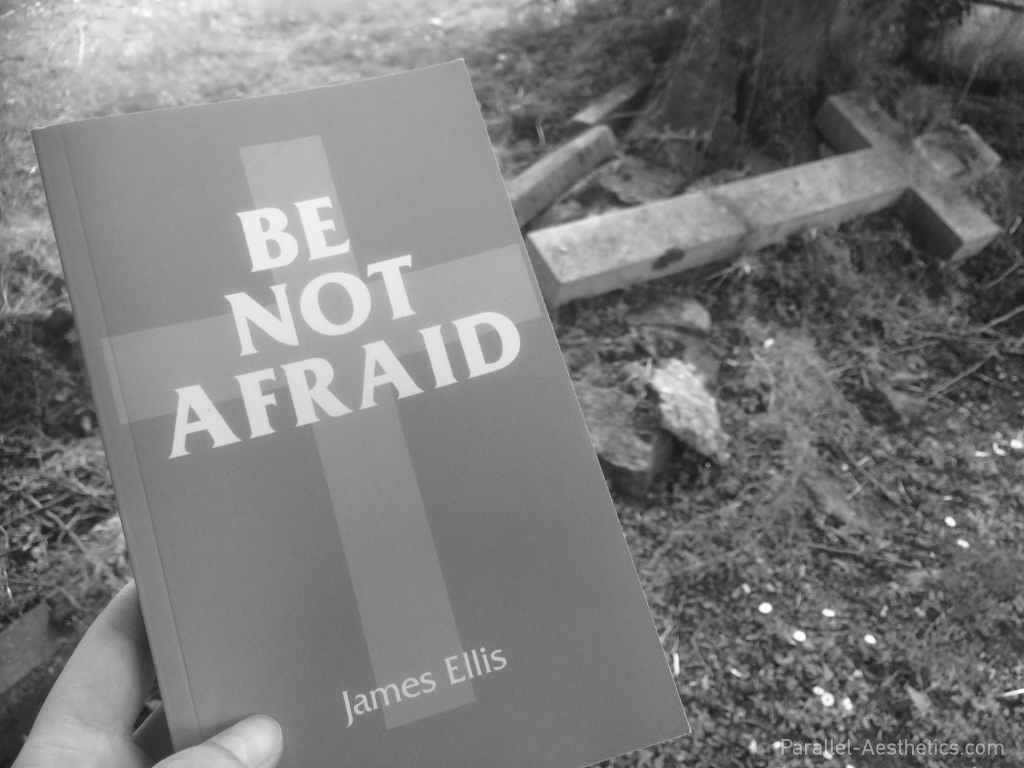
His most recent publication was a short novel called “Be Not Afraid.” It follows an unnamed protagonist – a young man – who works in the basement of a bakery. Every day is the same, time seems to disappear (its interesting that Ellis associates a state of non-time with nihilism). His manager is a rather eccentric figure called Ollneek who is more than happy to share his unsolicited cynical opinions on just about everything.
The young man feels the same sense of emptiness that Ellis has described in his other works. Its a feeling  worsened by Olneek’s frequent ramblings.
Eventually, various guardian angel figures intervene – we see Ollneeks sinister influence for what it really is and the young man finds his way to salvation.

The tail is a sort of parable in which Christianity triumphs over nihilism.

The emptiness of the modern world led Ellis to sink deep into the depths of nihilism – unable to go any further he looked upward and found a sense of meaning in Catholicism.

Collectively his works detail his inner journey – the journey of the Meta-Nomad but where he travels next is something yet to be seen.
Jack Grassby: An Obituary of a Philosopher

I recently learnt about the passing of Jack Grassby. Jack died on January 12th 2022 – only a few months before his 97th Birthday. I think it’s difficult to summarise Jack. He was a truly interesting and unique individual

During the Second World War he served in the navy. I don’t know much about his time at sea but I know on at least one occasion his ship was attacked by the Luftwaffe.
He became involved in local Socialist politics and the economic turmoil of the 1970s – something he documented in this book “The Unfinished Revolution: South Tyneside 1969-1976.”
It was also sometime in the 1970s that Jack helped found the annual Westoe Village fair.

Jack developed a deep interest in philosophy and became an important figure within local philosophical circles. He would frequently give lectures on behalf of such groups. It was at one of these public lectures that I first met Jack. I believe it was late 2015 and he gave a well informed talk on the philosophy of Nietzsche ironically in a church hall. He was already rather old at this point but despite his age his mind was still sharp. He could speak at length about complex matters such as the thinking of Derrida and Wittgenstein.

Jack’s abilities as a speaker were far surpassed by his abilities as an organiser. I’d seen Jack chair board meetings – maintaining order when rivalries were bitter and emotions ran high. Skills I suspect he perfected during his trade union days. On a few occasions I found myself disagreeing with some of his decisions – sometimes seeing that he was right in retrospect. Unlike other board members Jack was respected by his critics. I think its fair to say that when Jack Grassby spoke everyone stopped to listen.

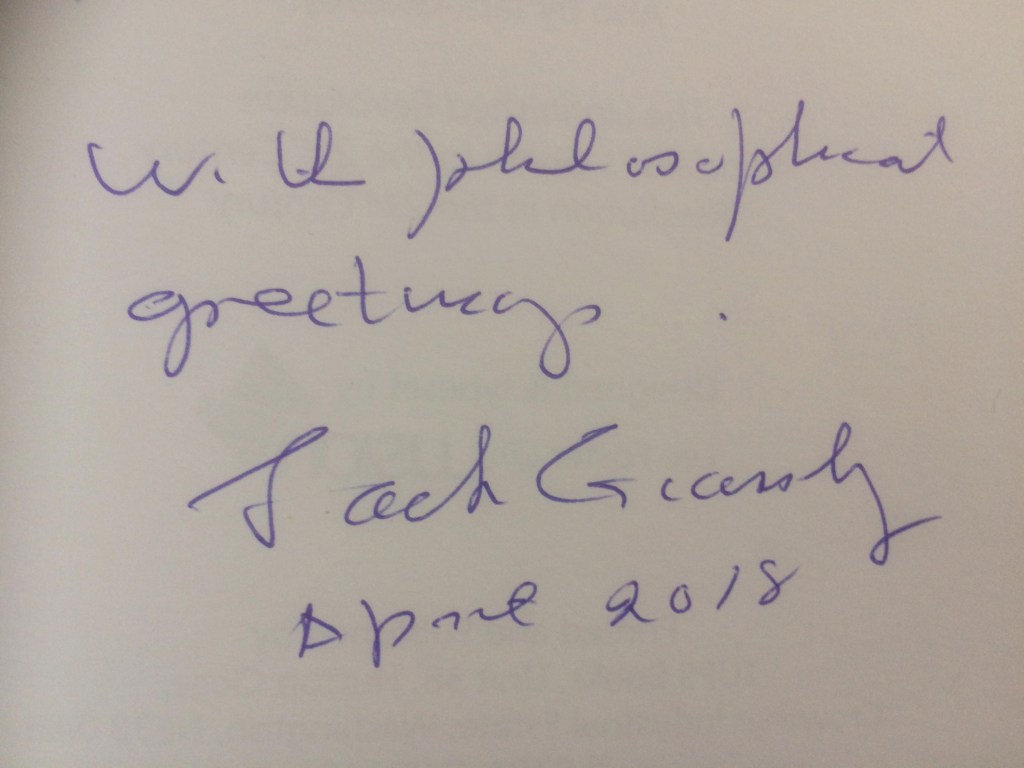
Jack authored several books on the topics of philosophy and local history. Unfortunately they’re all out of print. A friend and I once found a copy of his “Postmodern Humanism” in a used bookstore in Jesmond. I knew I’d be seeing him the following weekend and brought the book with me.
When I presented it to him he smiled and laughed saying “You know, this is all just student stuff.”
I asked him if he’d sign it and he did. That book is sitting on my shelf only a few feet away from me now as I type this article.

The last time I seen Jack was on a cold December day in 2019. We’d both attended a rather dry public lecture. Afterwards everyone planned to head to a pub across the road for food and drinks.
Jack and I spoke on our way there. We discussed the lecture, my first essay which I’d published a few months earlier, the state of the philosophy scene. Once we got there we’d sat at different tables but before he left he came over to me, said good bye and shook my hand. I’d enjoyed speaking with Jack that afternoon.

He and I exchanged emails for a while after that. By now I’d become rather critical of the philosophy scene and we discussed my criticism via email. Despite my criticism I never had any ill feeling towards Jack – he was one of the few people there I still had any respect for. The last messages we exchanged were in late 2020. I’d told him I was planning to write an essay on Lovecraft and he’d told me of his plans to write an essay on Nietzsche and language.
After that we lost contact. I’ve no idea if he ever finished that essay. I never finished mine on Lovecraft.

I know that Jack remained active in philosophical circles after that and only fully retired in his mid-Nineties shortly before his passing.
I’m disappointed no one I knew from the period informed me. I only found out after bumping into a mutual acquaintance. I discovered that the North East Humanists paid tribute to Jack in their newsletter but I never subscribed to it.
A friend and I had planned to make a short documentary on Jack. We’d pitched the idea to him and he seemed to be willing but due to the lockdowns the project never went ahead. I’m rather sad now to think this documentary was never produced.

Unfortunately Jacks website has now gone down. You can still find partly preserved on the “WayBack Machine.”
Although his books are out of print you can still occasionally find them in used book stores and libraries scattered around North-East England.
I was surprised to hear that Jacks’ artwork was on display at the Customs House art gallery in South Shields. I’d never known that Jack was an artist. I hope to make the trip to the gallery soon.

Despite everything he did and achieved – I think those who knew Jack will remember him for the strength of his character, his integrity and the strong influence he had on those around him.

I know that’s why I’ll remember him.

The American Astronaut (2001): Film Review

The American Astronaut – as obscure as it is unique. This film has been largely forgotten about and mentioned only on rare occasions in the deepest darkest corners of cinephile forums. Unfortunately the film is not available on any streaming platforms and the DVD is long out of print – pushing it further into the depths of obscurity. The American Astronaut is a musical Space-Western with the aesthetic of a 1950s B-Movie only bleaker.
The story is set in an alternative timeline in which space travel was pioneered by independent roughneck types rather than sophisticated scientists and noble Astronauts.
Here we don’t have any nice Star-Trek style space ships with flashy lights and glowing control panels – we have clapped out amateur space craft that looked like they are held together with tape and made in some ones garage out of whatever junk he could find. It’s a strange aesthetic that belongs in a genre that never came to be. A revision of Retrofuturism similar to now Steam Punk revised Retrofuturism – only this is gritty rather than goofy.
The film was written and directed by Cory McAbee who also plays the lead character Samuel Curtis (and whose band The Billy Nayer Show performed the soundtrack). Curtis is an independent Astronaut drifting from place to place, making deliveries wherever he needs to in order to make some cash. After delivering a cat to a client in a dive bar based on an asteroid – Curtis bumps into his old friend – the renowned fresh fruit smuggler – The Blueberry Pirate (Joshua Taylor) who involves him in a number of shady deals on numerous planets leading to one big score. The only problem being that Curtis is being followed by his old enemy – the murderous Professor Hess.
Despite its absurd story and musical numbers the film is played completely straight – no over the top or comic acting – these parts are played more seriously than those of a Shakespeare play. This crossed with the aesthetic contributes to the films uniqueness and strange feel.
I really enjoyed this one. I think it’s a shame this ones so overlooked. It’s a shame it’s so deeply buried when it has the potential to be a cult classic. The American Astronaut is something I’ll go around recommending to people knowing they may very well never see it.


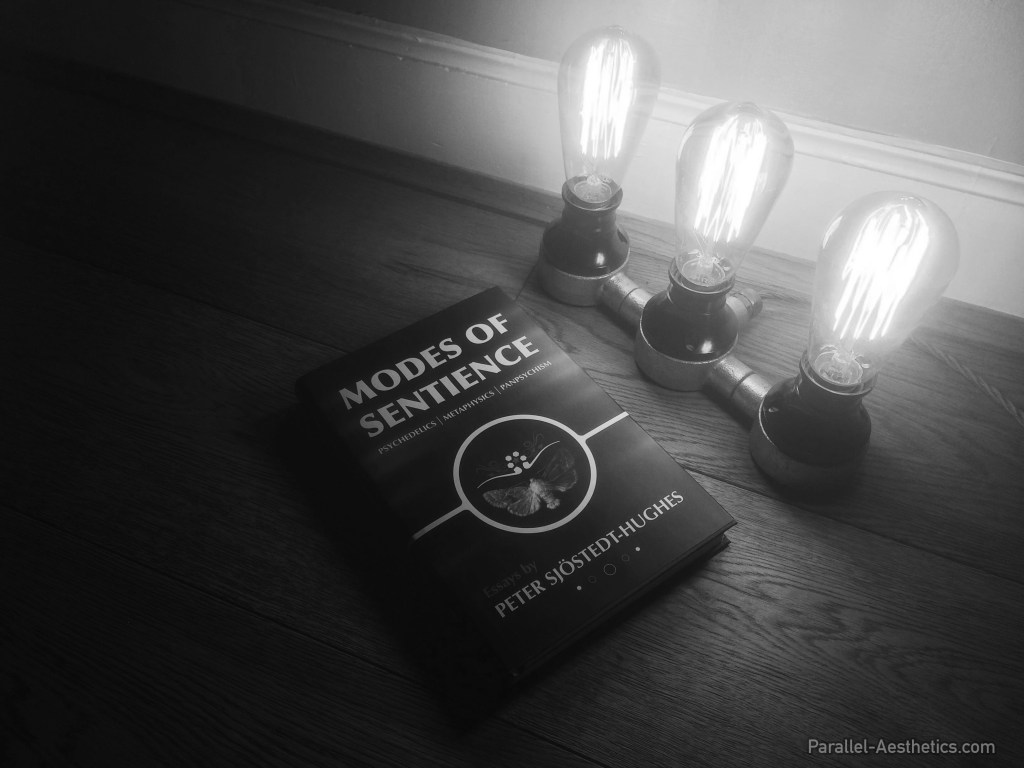
Modes of Sentience: Book Review

Six years after the publication of Noumenautics (2016) Dr. Peter Sjöstedt-Hughes brings us a new collection of essays, Modes of Sentience, in which he continues his exploration of Psychedelic experience, Metaphysics and Consciousness. Unlike this previous book there is no exploration of Meta-Ethics.

Many of the chapters are deeply complex such as “The Great God Pan is not Dead,” which explores Whiteheads Metaphysics in relation to Psychedelics perception and “Deeper then Depth,” which explores space and sentience. I don’t want to summarise these more complex essays here. Doing so would take up to much space for this to remain a simple review and I do not think a short summary would present such ideas adequately. Instead I will briefly discuss what could be seen as the more “approachable” essays.

“The Concrescence of Dissent” is a fantastic essay exploring the development of Alfred North Whitehead within the Religious and Philosophical context of his time  – showing that Whitehead stood as a heretic amongst his contemporaries. An interesting article for those both new to Whitehead and those already knowledgeable of his work.

The book also contains perhaps one of Sjöstedt-Hughes most significant essays: “The Psychedelic history of Philosophy.” Which gained almost instant popularity after its original publication in Mid-2016. This essay explores the hidden influence of Psychedelics have had on Western Philosophy exploring usage from Plato to Foucault. Here Sjöstedt-Hughes provides us an alternative view of Western Philosophy and discusses figures both well known and obscure.

One such obscure figure is Sir Humphry Davy, who is further discussed in the essay “The First Scientific Psychonaut.” Davy is best remembered for inventing the miners lamp and isolating several elements however he want on to experiment heavily with Nitrous Oxide – inspiring a poetic philosophy of Metaphysics of which Sjöstedt-Hughes explains in detail.

Modes of Sentience is a compelling and complex read. I wish not to discourage or criticise by mentioning its  complexity – I enjoy a challenging read. I don’t think ideas like these can be presented simply and in many ways I feel this book continues on from the writing he presented several years earlier – Modes of Sentience brings us deeper into Sjöstedts Psychonautic voyage. But we have further to travel yet as in the past Dr. Sjöstedt-Hughes has stated that he hopes to combine the metaphysics of Whitehead with the philosophy of Nietzsche.